

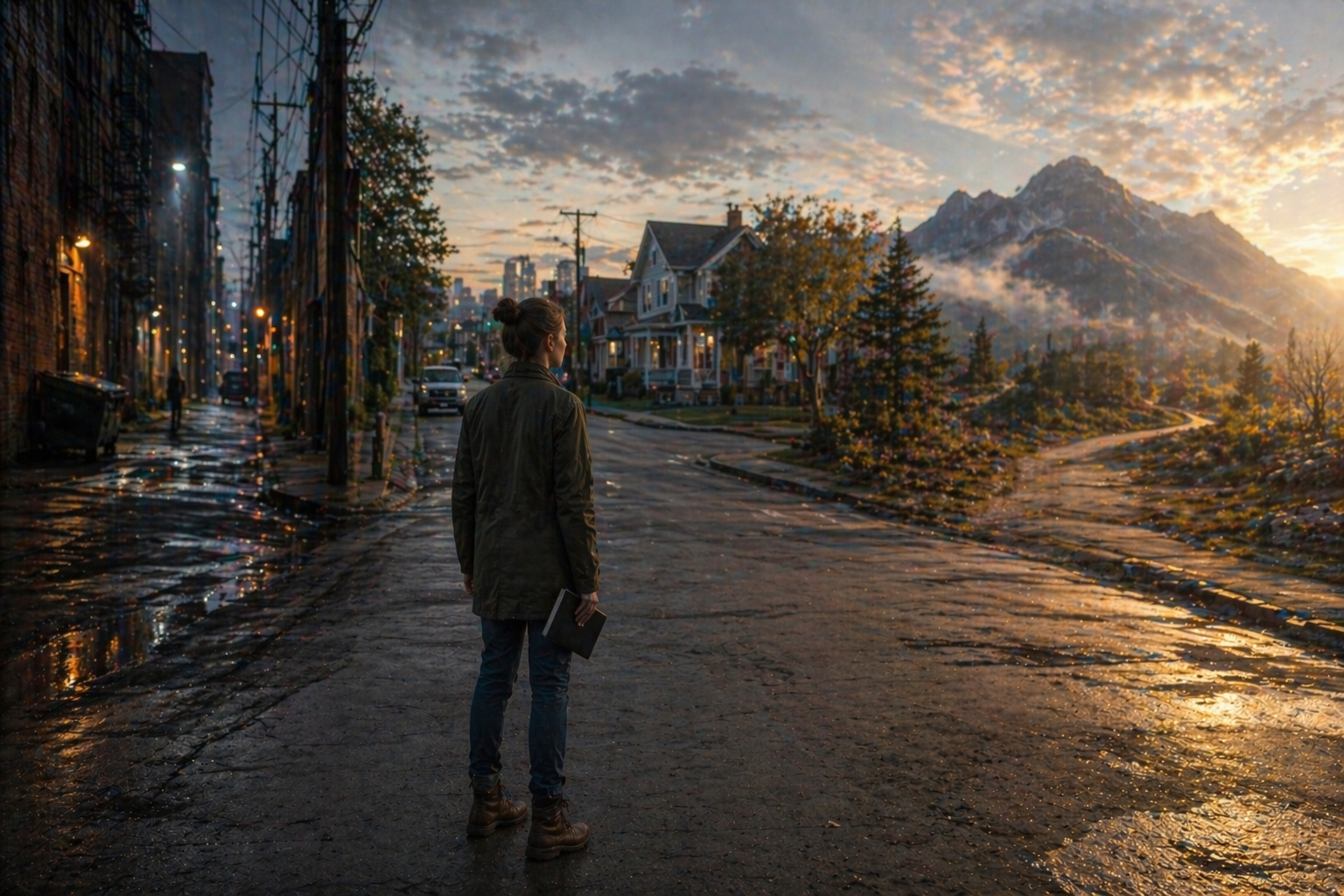
The Craft of Screenwriting – The Power of Place: How Setting Shapes Story, Character, and Conflict
If your story could happen anywhere, it will feel like it belongs nowhere.
Every story happens somewhere. That may sound obvious, but many writers still treat setting as an afterthought—as a backdrop, a container, a place to put the action. In strong screenwriting, place does much more than hold the story. It shapes it. It influences behavior, creates pressure, reinforces theme, and often becomes so essential to the drama that the story would collapse without it.
A screenplay does not unfold in empty space. It unfolds in a world—physical, cultural, emotional, and psychological. That world affects what your characters fear, what they desire, what they believe is possible, and how far they are willing to go when pushed.
Think about Pan’s Labyrinth, Mad Max: Fury Road, The Godfather, or Get Out. These films do not simply have memorable settings. They have worlds that actively shape tone, conflict, identity, and meaning. Remove those environments, and you do not have the same story. That is the real power of place in storytelling.
Worldbuilding Is Not Just for Fantasy and Science Fiction
When writers hear the word worldbuilding, many immediately think of fantasy kingdoms, dystopian futures, or sprawling science fiction epics. Those genres certainly demand it, but the principle applies just as much to grounded drama, comedy, thriller, and horror. Every story creates a world, even if that world looks familiar on the surface.
The office in The Devil Wears Prada is not just an office. It is hierarchy, pressure, status, and fear. The island in The Banshees of Inisherin reflects isolation, stubbornness, and emotional decay. The town in Three Billboards Outside Ebbing, Missouri carries grief, resentment, and tension in every interaction. In each case, the setting is not passive. It is shaping behavior and driving conflict.
A Story World Needs More Than Surface Detail
A convincing setting is not built through decoration alone. Knowing your story takes place in a city, a desert, or a small town is not enough. Those are starting points, not finished dramatic choices. What matters is what governs that world.
What kind of space defines daily life? Is it crowded or isolated? Controlled or chaotic? Decaying or polished? What rules shape behavior—legal, social, moral, or unspoken? What history led to the present condition? Who holds power, and how is that power maintained? How do ordinary people work, survive, hide, and connect?
These questions create texture, and texture gives a world weight. Without it, the setting feels generic. With it, the story begins to feel inevitable. This is also where many writers struggle with translating ideas into something cinematic—something that can be seen and felt rather than explained. If you haven’t already, this is where understanding visual storytelling becomes critical to how your world comes across on screen.
In Screenwriting, the World Must Be Seen
Screenwriting is not about explaining a world. It is about revealing it. The audience does not experience your story through exposition. They experience it through what they can see and hear, which means the world must emerge through image, behavior, and implication.
Do not tell us the world is dangerous. Show armed patrols moving through an otherwise ordinary street. Do not tell us something is forbidden. Show the consequences when someone breaks the rule. Do not explain division. Show it in how people avoid each other, speak carefully, or move through shared space.
This is where your approach to visual storytelling directly impacts the strength of your screenplay. The more clearly you understand how to communicate through image, the more alive your world becomes.
Costume, architecture, background action, and environment all carry meaning. The condition of a space—clean, broken, crowded, silent—shapes how the audience understands the world. The goal is not to inform the audience. It is to immerse them.
Place Shapes Character
Characters are not separate from their environment. They are shaped by it. The world determines how they speak, what they fear, what they hide, and what they believe is possible. It influences how they move through space and how they respond under pressure.
A character raised in an oppressive system may speak carefully, hide emotion, and avoid attention until forced to act. A character raised in privilege may move with confidence, expecting access and control. A character from a failing town may carry quiet resignation. A character from a violent environment may see danger as normal.
When the world presses against the character, tension builds. When the character resists that pressure, story begins to move. That friction between person and place is where compelling drama lives. If you want to deepen this further, it connects directly to how you build characters from the ground up—how their internal life and external world collide to create meaningful conflict.
The Best Story Worlds Are Built with Restraint
One of the fastest ways to weaken a screenplay is to overload it with unnecessary detail. Writers often mistake worldbuilding for quantity—more lore, more backstory, more explanation. In reality, strong worldbuilding is selective. It focuses on the details that matter most.
If a detail affects the plot, reveals character, reinforces theme, or increases tension, it earns its place. If it exists only because it sounds interesting, it becomes noise. Discipline is what gives a world clarity, and clarity is what gives it power.
Films That Use Setting as Story
Some films demonstrate this principle with precision. In Children of Men, a collapsing future is revealed through everyday life—graffiti, propaganda, behavior, and exhaustion. The world is never fully explained, but it is constantly felt.
In Her, the soft, minimal, emotionally muted environment reflects loneliness and the desire for connection. The design of the world supports the emotional core of the story.
In The Witch, isolation and rigid belief systems create suffocating tension. The setting is not separate from the horror—it is what allows the horror to exist.
In each case, the environment does more than support the story. It defines it.
Final Thought
You are not just building a place. You are building pressure, limits, culture, and tension. A believable world gives your story weight because it gives your characters something real to live inside—and something real to fight against.
When setting is used well, it speaks before anyone says a word. It tells us what matters, what is broken, what is dangerous, and what your characters have learned to accept. More importantly, it reveals what they may finally be forced to confront.
If you want to go deeper into building characters that feel as real and dynamic as the worlds they inhabit, Mastering Character Creation breaks down the full process step by step—from foundational concepts to advanced techniques you can apply immediately.
That is why place matters. It is not background. It is story.
Fade In Is Just The Beginning.

The Craft of Writing: Why Strong Female Characters Matter (And Why Most Writers Still Get Them Wrong)

The Craft of Writing: Beyond the Heroine — Writing Nuanced Female Protagonists

THE CRAFT OF WRITING: Seeing Your Characters – Using AI Images as a Writing Reference Tool

John Risner
John Morgan Risner is a screenwriter, novelist, and story analyst, and the founder of Screen Writer Ink. With over a decade of experience teaching screenwriting and filmmaking at the university level, he has helped writers develop stronger stories through a focus on character, structure, and cinematic storytelling. His work spans multiple genres, including thriller, horror, and mystery, with an emphasis on character-driven narratives. He is also a film historian with a deep knowledge of classic and modern cinema, including the James Bond films and novels. Through Screen Writer Ink, he provides writers with practical, experience-based insight into the craft of storytelling—helping them move beyond theory and write with clarity, purpose, and control.


